

author & date of publication: Tomas | 4.3.2026
In the traditional world, information is asymmetric, fragmented, and often burdened by the cognitive biases of experts who bear no financial responsibility for their errors. Prediction markets radically transform this model. They are not oracles, but decentralized computational engines that convert the dispersed knowledge of millions of entities into a single, highly liquid metric: market price.
While public opinion polls measure only “cheap talk”, prediction markets require a capital commitment. This principle of relentless feedback means that those who are correct accumulate capital and influence over future prices, while those who are wrong lose it. The result is a constantly refining source of truth that often reacts to global events faster than Bloomberg terminals or news channels.
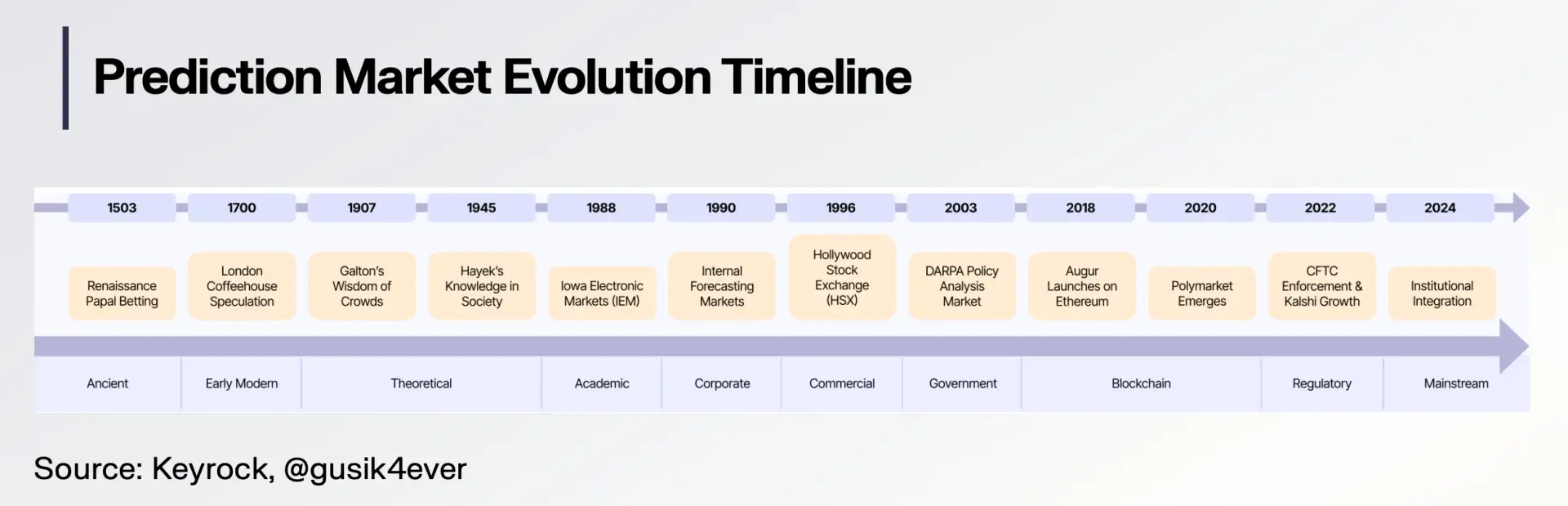
Most users associate prediction markets with the simplest format, but the reality is much richer:
The spectrum of markets is expanding dramatically and now covers almost every measurable variable of human existence:
For investors, a prediction market is not a venue for gambling; it is a vital tool for hedging. If you hold a portfolio heavily dependent on a specific technological narrative, a prediction market allows you to open a position against that outcome. If the negative scenario unfolds, the profit from the prediction market offsets the loss in your portfolio. It represents the only financial layer that allows for the efficient trading of event-specific risk that traditional derivatives (such as options or futures) cannot cover.
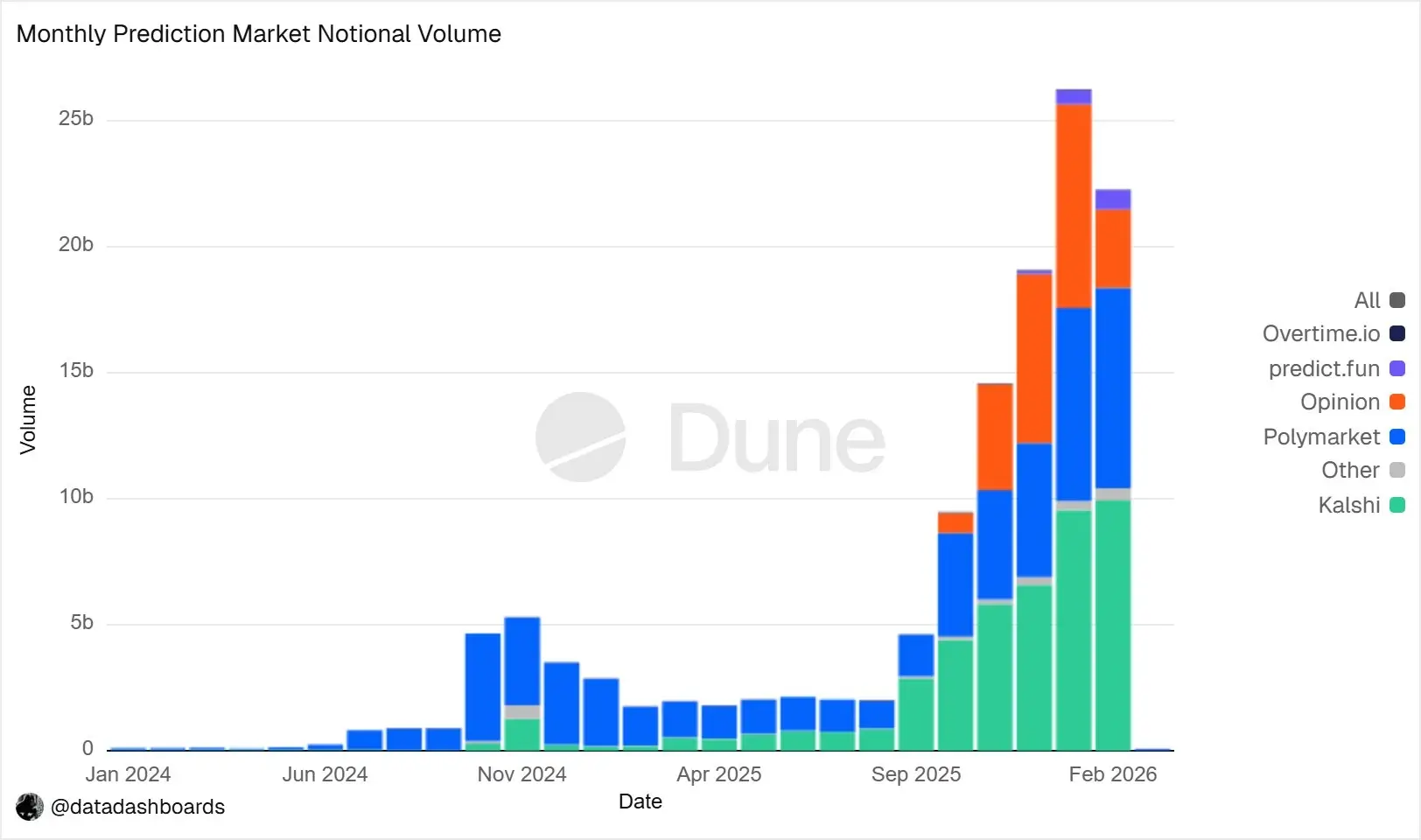
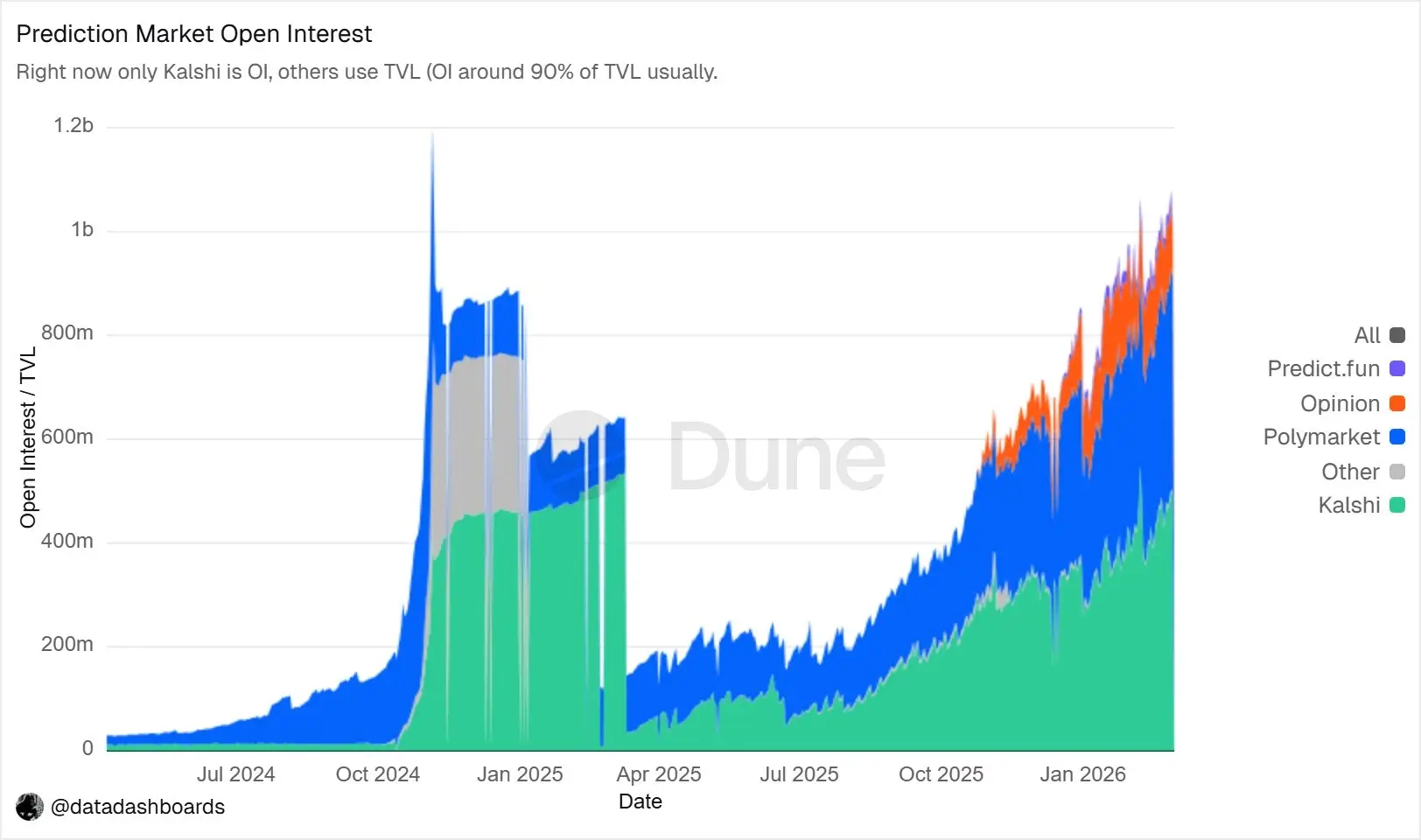
While only two years ago prediction markets were considered a niche interest, current data from February 2026 paints a picture of a highly dynamic, multi-billion dollar industry. The market has moved past its maturation phase, and today we are witnessing a fierce battle for liquidity among several dominant ecosystems. A significant signal of institutional adoption is the fact that Nasdaq seeks SEC approval for prediction-style binary options tied to the flagship 100 index, bringing prediction mechanisms into the very core of traditional finance. Also noteworthy is the recent news that Predict.fun has completed its strategic acquisition of Probable.
Notional Volume: This metric reflects the total financial depth and the market’s ability to absorb capital. February data shows a clear dominance by Kalshi with a volume of $9.9 billion. Following closely is Polymarket at $7.9 billion, confirming that these two entities form a duopoly controlling the majority of global prediction money flow. Opinion Labs is the “breakout” performer with $3.1 billion, suggesting a growing investor appetite for alternative platforms outside the mainstream.
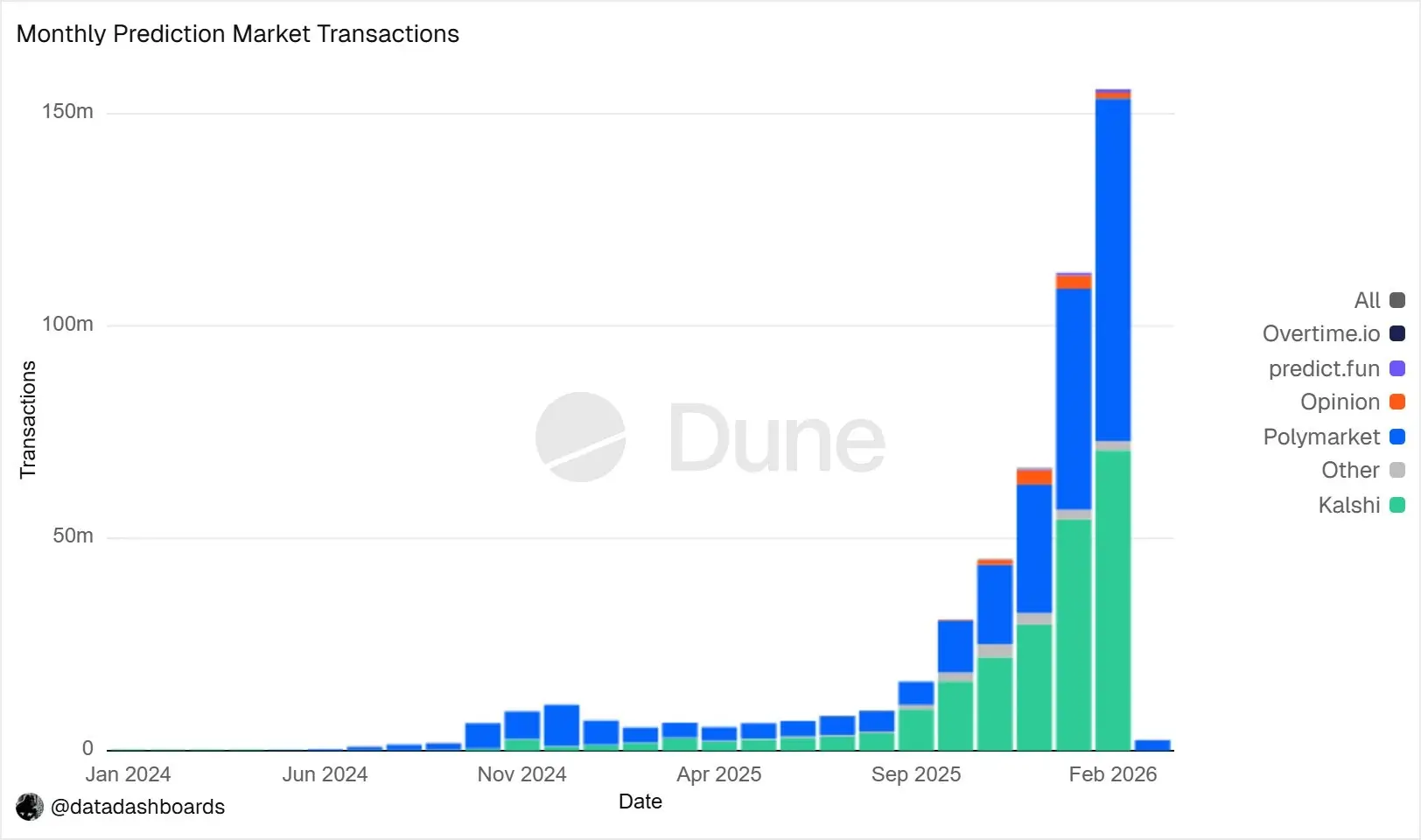
Transactions: In terms of transaction count, Polymarket wins by a landslide with 80.7 million transactions. This indicates extremely high retail activity and the deployment of algorithmic bots that constantly arbitrage and correct prices. Kalshi, with 70.8 million transactions, maintains high efficiency; when combined with its top-tier volume, this points to the presence of large institutional players. Other platforms lag significantly in this category.
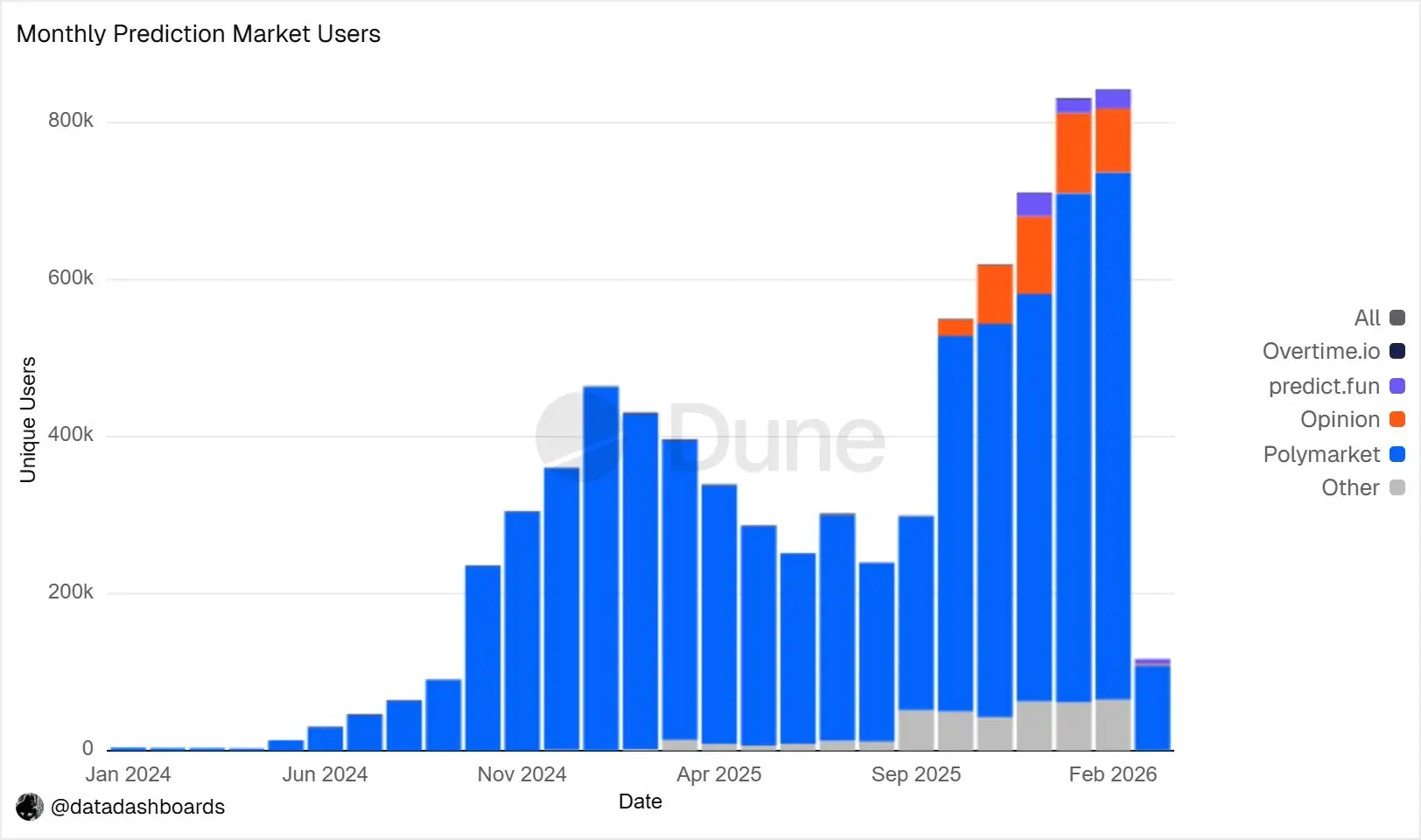
Unique Users: The user base is the best indicator of adoption. Polymarket leads by a massive margin with 671,000 active users (data for Kalshi is currently unavailable). The second-largest community belongs to Opinion Labs with 81,000 users, while specialized platforms like Predict.fun serve approximately 24,000 users.
Open Interest: Open Interest – the value of capital locked in active bets – reached record levels in February 2026, with Kalshi holding $492 million and Polymarket $410 million. The growth of total Open Interest toward the $1 billion mark confirms that users are utilizing these markets for long-term hedging rather than just short-term speculation. This indicator is crucial for ecosystem stability, as it demonstrates participants’ sustained trust in the final settlement of events.
Despite staggering growth and billion-dollar volumes, prediction markets face profound structural hurdles that could impede their transition into the true mainstream.
One of the primary drags on the sector is capital inefficiency. Unlike traditional exchanges where you can trade on margin (leverage) by depositing only a fraction of the position value, prediction markets typically require full collateralization. This makes them 10x to 20x less efficient in terms of capital utility than modern crypto derivatives. Furthermore, your capital is “trapped” in the market until the event’s final resolution. Market leaders like Polymarket are beginning to address this by offering yields (e.g., around 4%) on locked capital in certain long-dated markets, ensuring the time value of money is not entirely lost.
Fragmentation is a critical threat to forecasting accuracy. When the same event is traded across multiple platforms or fragmented into different market types, capital is split into isolated pools. This dilutes price discovery, as no single market possesses enough depth to reflect a true global signal. For institutional players, this fragmentation makes it nearly impossible to execute large trades without causing significant adverse price slippage.
In traditional markets like oil or equities, liquidity is persistent and cumulative. Prediction markets operate differently: once an event occurs, the market ceases to exist, and liquidity must be rebuilt from scratch for the next question. This is unattractive for Market Makers who cannot seamlessly rotate their positions.
Additionally, the ecosystem lacks “natural hedgers”. While an airline must hedge against rising fuel prices, few entities have a systemic economic necessity to hedge against election results or specific scientific milestones. This often leaves professional traders profiting primarily at the expense of less-informed retail users. Without constant subsidies and incentives, spreads on most markets would likely widen to prohibitive levels.
The core promise of these platforms is the Wisdom of Crowds, yet practice reveals two psychological pitfalls:
The integrity of a market relies on the Oracle – the entity that decides the final outcome. While decentralized oracles are transparent, they can be vulnerable to manipulation by wealthy actors if the value at stake exceeds the cost of corrupting the oracle itself. Furthermore, the specific phrasing of a market’s rules can be engineered to favor one side. Without rigorous oversight, a single “whale” can move a thin market to manipulate the perceived reality or the final settlement.
The legal status of prediction markets remains inconsistent globally, creating a risky “gray zone”. While licensed platforms like Kalshi must comply with strict regulations and limit the types of listed markets, decentralized protocols often operate in a legal vacuum. This clash between regulators, who demand forecasting utility, and platforms, which profit from betting volume, leads to inconsistent decisions regarding product features.
Prediction markets are no longer just a product category; they are becoming a fundamental layer for information aggregation and risk transfer. This transformation into a “market primitive” means that a complex technological stack is emerging above the core engine, enabling scaling, specialization, and mass distribution.
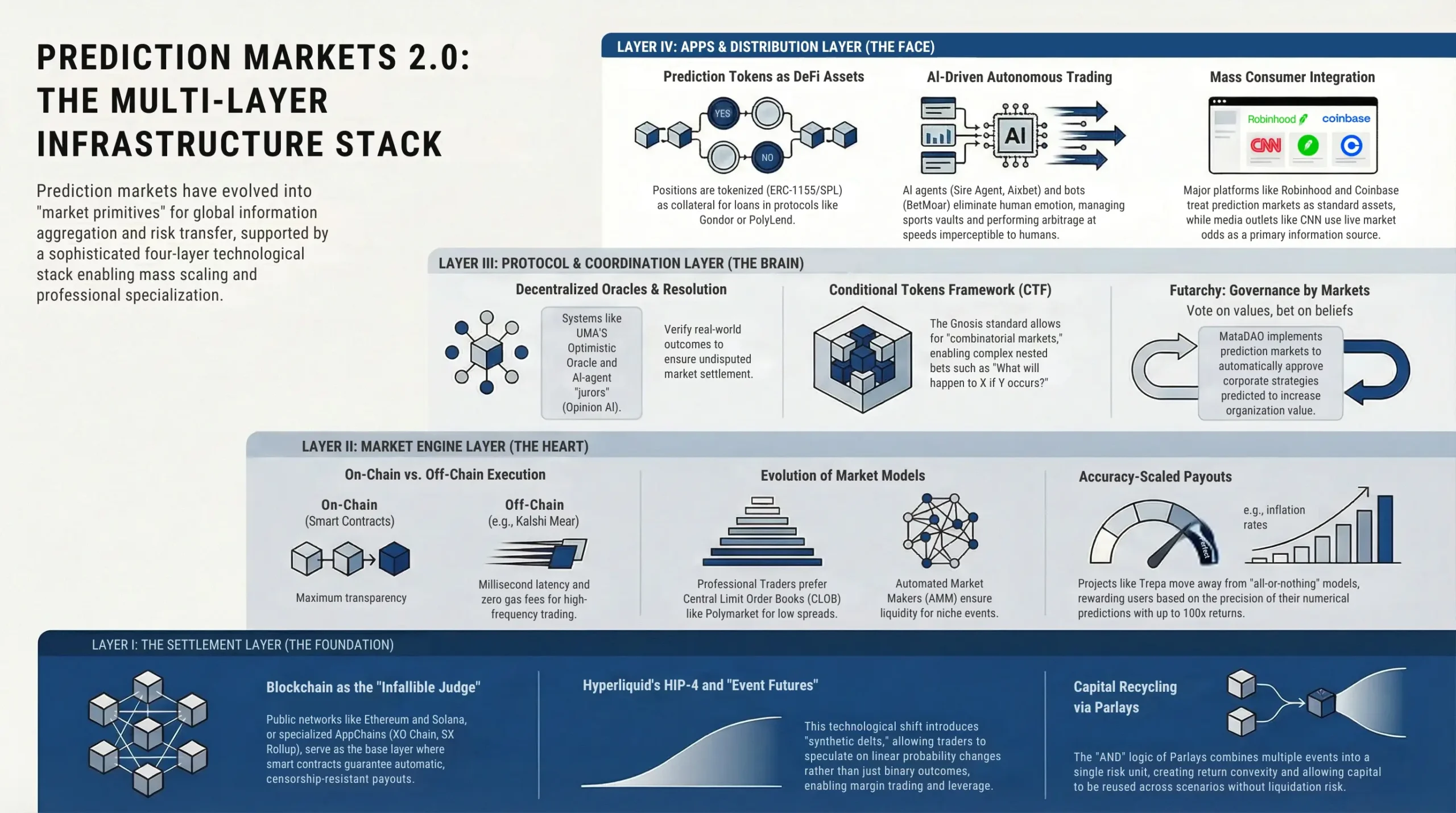
The settlement layer is the cornerstone of the entire system, where the blockchain serves as an indisputable judge and guarantor of all payouts. This purpose is served by established public networks such as Ethereum (ETH), Polygon (POL), Solana (SOL), or BNB Chain, as well as specialized AppChains – for instance, XO Chain, SX Rollup, and likely a future L2 from Polymarket.
Thanks to smart contracts, profit distribution occurs automatically and securely immediately after a result is confirmed, completely eliminating the risk of an operator blocking funds. Furthermore, the transition to specialized chains allows platforms to handle massive user surges with minimal fees and lightning speed – performance that general-purpose networks theoretically cannot guarantee during peak times. Own infrastructure grants platforms full control over security and rules, merging the speed of modern exchanges with the ironclad certainty of decentralized settlement.
The technological design of Hyperliquid’s HIP-4 represents a shift in capital efficiency through the introduction of Event Futures and Parlays.
This layer represents the technological heart of the system, where order matching and continuous price discovery take place. While lower layers handle security and data logging, the Market Engine Layer defines economic efficiency and the user trading experience.
Market efficiency depends on the mathematical model that determines the current price:
The market is constantly evolving toward better UX and higher capital efficiency, as demonstrated by the following projects:
This layer acts as the “brain” of the entire ecosystem, coordinating rules, ascertaining the truth, and connecting markets with the real world. While market engines handle execution, this layer focuses on creation and evaluation.
Secure and indisputable evaluation of outcomes is the bedrock of every market.
Instead of building applications from scratch, developers use ready-made “building blocks” (Programmable Modules) that allow them to launch a market or app in minutes.
Integration with DAO tools where prediction markets serve as the basis for decision-making – a concept known as Futarchy, where an organization’s strategy is decided by market estimates of its future success.
Yuki acts as a coordination and liquidity “cushioning layer” built atop Polymarket. It addresses the issue of low on-chain depth by providing additional financial incentives (often from third parties). These rewards are paid out regardless of trade direction for behaviors that improve market quality – such as maintaining tight spreads or providing continuous liquidity – reducing risk for market makers without skewing price discovery. The process is simplified for users via tokenized vaults (ERC-4626 standard), which automate complex strategies and transform binary tokens into structured financial products with improved risk profiles.
The uppermost layer is where the end-user interacts with the system. This is the stage where mass adoption occurs through interfaces that are either familiar to people or designed for maximum accessibility.
Professional terminals such as Fireplace, Verso, OCX, TradeFox, and Kalshinomics are transforming prediction markets into true “market primitives”. They provide high-performance interfaces that feel like modern trading applications rather than mathematical puzzles. These platforms focus on maximizing Alpha & Information Flow by integrating AI research layers and social sentiment aggregators, helping traders identify trends before they hit the mainstream.
A key feature is the drastic reduction of News-to-Trade latency, achieved through “One-Click Trading,” whale-watching alerts, and custom scripting environments for automation. Advanced Risk Management is also integral, offering unified P&L tracking and hedging tools across various markets – essential for professional portfolio management.
Simultaneously, aggregators like Converge, Kairos, Matchr, Fors, Wandly, and Chance tackle liquidity fragmentation via Multi-venue integration and Smart Order Routing (SOR). By creating virtual order books and normalizing disparate market standards, these tools ensure users always receive the best possible price, regardless of the platform where the market originated. Beyond simple routing, these aggregators introduce automation through investment vaults, copy-trading, and agentic systems, making sophisticated strategies accessible to a wider audience. This layer of aggregation and automation is what ultimately unlocks new modes of governance, financing, and information prioritization in the public sphere.
By tokenizing positions (e.g., via ERC-1155 or SPL), these “bets” can be utilized as full-fledged assets for loans, leveraged trades, or sophisticated capital management.
These protocols solve the problem of “trapped” capital in long-term bets by allowing open positions to be used as collateral.
For advanced risk management and aggressive speculation:
Autonomous entities analyze vast amounts of data and execute trades with sub-perceptual latency. Key tools include BetMoar (official bot provider for Polymarket) and ArbBets (specializing in lightning-fast arbitrage). Automation is democratized via PolyGun (a dominant Telegram trading bot) and PredictEngine.ai (no-code bot builder). The pinnacle of intelligent betting is represented by AI agents like Sire Agent and Aixbet, which use machine learning to autonomously manage sports vaults and optimize bets based on deep statistics.
Financial giants like Robinhood and Coinbase have integrated prediction markets as standard investment tools alongside stocks and crypto. Robinhood utilizes event contracts (e.g., from Kalshi) for macroeconomic speculation, while Coinbase connects users directly to Polymarket’s on-chain liquidity, handling all technical complexity in the background. This trend is bolstered by mass adoption in media:
In the sports segment, leaders like DraftKings and FanDuel are joined by PrizePicks, which integrates Kalshi-powered markets into its fantasy sports app. Strategic partnerships, such as the NHL licensing official data for hockey markets since October 2025, further drive this shift. Supported by seamless access via wallets like Phantom and Trust Wallet, the technology has been completely abstracted. Users no longer distinguish between a bet and an on-chain contract; prediction markets have become the indispensable “truth filter” people turn to for an objective view of future probabilities.
In 2026, prediction markets have definitively established themselves as a professional “operating system for truth”. This system is no longer perceived as a mere speculative platform, but as a decentralized computational engine that aggregates the dispersed knowledge of millions of entities through market price into a single, highly liquid signal. Unlike traditional polls and media, which often deal in non-binding opinions, prediction markets require a direct capital commitment. This relentlessly eliminates cognitive biases and creates the most accurate possible filter of reality.
A crucial milestone is their integration into mainstream media – the fact that CNN utilizes this data as a valid probability metric definitively legitimizes prediction markets in the eyes of the global public. To achieve true mass and institutional adoption, however, the focus is now shifting toward building a comprehensive ecosystem and professional-grade tools. This includes advanced trading terminals, liquidity aggregators, and sophisticated risk management systems capable of handling high-frequency data and massive volumes.
It is this layer of professional infrastructure, combined with total technological abstraction, that allows prediction markets to function as the most accurate filter of reality, surpassing the capabilities of any traditional institution through its sheer speed and objectivity.